
⁃ Chattanooga, TN ⁃
What Does a Deck Cost in Chattanooga?
The honest answer is that it depends on more than square footage — and any contractor who gives you a firm number before seeing your lot is guessing. What follows is how deck pricing actually works, so you can figure out roughly where your project lands before anyone comes out.
We're Arellano Construction. We've been building decks across Hamilton County for more than ten years, and we've quoted a lot of projects that came in higher than the homeowner expected and a fair number that came in lower. Both usually trace back to the same handful of factors.
⁃ The Six Things That Move the Number ⁃
What Actually Drives Deck Cost
Two decks the same size can differ substantially in price. Here's why.
1. Height off the ground
This moves the number more than almost anything else, and it surprises people. A ground-level deck sits on short posts and simple footings. Raise that same deck eight or ten feet and you need taller posts, deeper footings, lateral bracing, stairs, and railing on every side. The surface area didn't change — the structure underneath it did.
2. Material
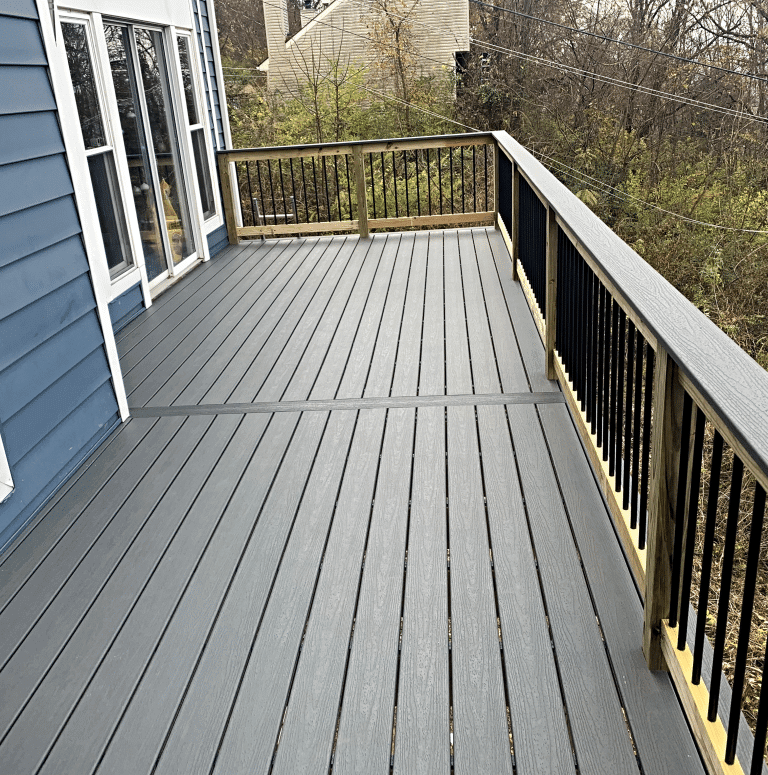
Pressure-treated pine is the least expensive way to get a deck built. Composite costs meaningfully more up front and nothing after. Between those sits cedar and the mid-tier composite lines. The gap between wood and composite on a large deck is real money, which is why we price both when it's a close call.
3. Your lot
Grade, rock, drainage, and access all show up in the price. A steep lot means more structure. Shallow bedrock changes how footings get set. A narrow side yard means every board gets carried by hand instead of wheeled around. We walk the access route during the estimate for exactly this reason.
4. Railing
Railing is a bigger line item than most homeowners expect, and it's where budgets quietly stretch. Standard picket railing is the baseline. Cable rail and glass panel systems cost considerably more, and on a brow lot with a view they're often worth it. It's worth deciding early rather than at the end.
5. Covered or open
A roof over the deck is essentially a second structure — posts sized to carry it, framing, roofing, and tying into the existing roofline so it looks original rather than added on. It's a significant addition to the cost and it's also what turns a three-season space into one you use most of the year.
6. Everything built in
Stairs, benches, planters, lighting, skirting, and under-deck drainage each add. None of them are large on their own; together they can move a project a full tier. Worth listing what you actually want before you compare quotes, because a cheaper number often just means fewer of these.
⁃ Common Deck Sizes ⁃
How Big Is the Deck You're Picturing?
Most homeowners describe a deck by its footprint. Here's what those dimensions actually give you, which is useful context before you talk to anyone about price.
| Size | Square feet | What it comfortably fits |
|---|---|---|
| 10×12 | 120 sq ft | A small table and two or three chairs. Tight for entertaining. |
| 12×16 | 192 sq ft | Dining table for six, or a grill and a small seating area. |
| 12×20 | 240 sq ft | Dining plus a separate seating zone. A common sweet spot. |
| 16×20 | 320 sq ft | Full outdoor living — dining, seating, grill station. |
| 16×24 | 384 sq ft | Room for distinct zones, or a hot tub with space left over. |
| 20×24 | 480 sq ft | Large multi-purpose space. Often built as multi-level. |
Square footage alone won't tell you the price — a 240 square foot deck eight feet off the ground costs substantially more than the same deck at ground level. But it's the right place to start the conversation.
⁃ The Decision That Matters Most ⁃
Composite or Pressure-Treated?
This is the single biggest lever on your budget, and the right answer depends on how long you plan to be in the house.
Pressure-treated pine costs the least to build. It also needs cleaning, sanding, and staining on a schedule — realistically every two to three years around here. Most homeowners keep that up for a few years and then stop, which is why so many decks in Chattanooga look tired by year eight.
Composite — Trex, TimberTech, and similar — costs more up front and then costs nothing. It doesn't absorb water, doesn't splinter, and holds its color. On a shaded lot, near the lake, or anywhere under heavy tree cover, the difference shows up within a few seasons.
If you're staying in the house ten years or more, composite usually wins on total cost. If you're selling in three, pressure-treated may be the smarter spend. We'll price both.
⁃ Comparing Quotes ⁃
Why One Quote Comes In Lower Than Another
When two estimates differ by thousands, it's rarely because one builder is cheaper. It's usually because they're not quoting the same job. These are the things that tend to be missing from the lower number.
- Permits and inspections. Most deck projects require a permit. If a quote doesn't mention it, ask who's pulling it and whether it's included.
- HOA drawings and specs. If your neighborhood has architectural review, someone has to prepare that submission. That's real time.
- Site conditions. Difficult access, steep grade, and rock all add labor. A quote given from the street doesn't account for what's behind the house.
- Demolition and disposal. Tearing out an old deck and hauling it off isn't free, and it's easy to leave out of a number.
- Structural work on existing framing. On a replacement, the old framing and ledger board need evaluating. Building new boards over failing structure is cheaper and it doesn't last.
- Railing and stairs. Sometimes quoted separately, sometimes assumed. Confirm which.
- Grading and cleanup. What the yard looks like when the crew leaves.
None of this means a lower quote is dishonest. But it does mean the numbers aren't comparable until you know what each one covers.
Want a real number for your project? We'll come out, walk the space, and give you a written estimate with the scope spelled out. Free, no obligation, and no pressure to decide while we're standing there.
How We Arrive at Your Number
We don't quote decks over the phone, and we'd be suspicious of anyone who does. Here's what actually happens.
We come out and walk the space with you — the grade, the access, where the sun hits, how the deck ties into the house, and what you actually plan to do out there. That last part matters more than people expect; a deck built for grilling and a deck built for entertaining twelve people aren't the same deck.
Then we talk through material and railing, and we bring composite samples so you're choosing off real boards in your own light rather than off a screen.
You get a written estimate with the scope spelled out, including anything about your site that affects the work. If a difficult access route is going to add labor, that's in the number up front rather than showing up later as a change order.
What we'd suggest before you call anyone
Know roughly what size you want. Even approximate dimensions make the conversation faster.
Decide how you'll use it. Dining, lounging, hot tub, grilling — it changes the layout more than the size does.
Think about how long you're staying. This is what settles the composite question.
Check whether you have an HOA. If so, find out what the review process requires before you're on a schedule.
Have a range in mind. Not a firm budget — just a sense of what's comfortable. It lets a builder design toward something realistic instead of showing you a deck you don't want to pay for.
Where We Build
We're based in Chattanooga and build throughout Hamilton County and into North Georgia. Costs don't vary much across the area — what varies is the lot.
- Signal Mountain
- Lookout Mountain
- Ooltewah
- Hixson
- Soddy-Daisy
- Red Bank
- Collegedale
- East Brainerd
- Ringgold
- East Ridge
- Harrison
- Chattanooga
⁃ Common Questions ⁃