

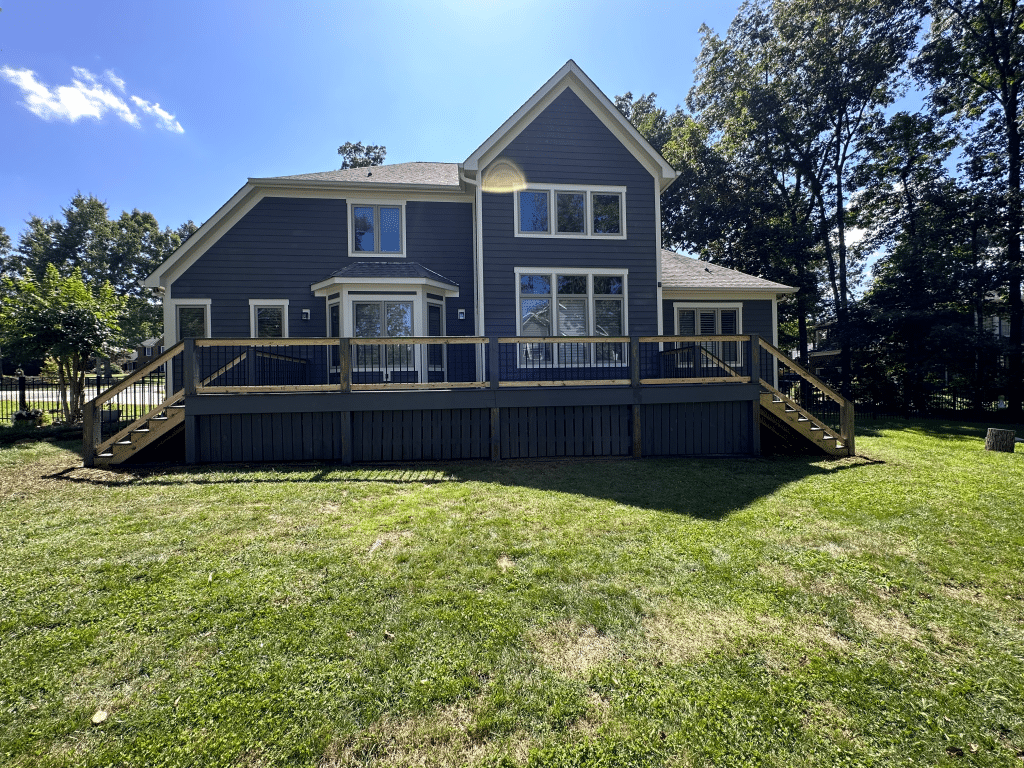
⁃ Chattanooga, TN ⁃
Composite or Wood? An Honest Comparison
Composite decking has largely replaced wood as the default choice for new decks around here, and for most homeowners in this climate that's the right call. But it isn't the right call for everyone, and it has real drawbacks worth knowing about before you commit.
We build both. Below is what each material actually does over its lifespan, where composite genuinely wins, where wood still makes sense, and the four downsides of composite that don't get mentioned often enough.
⁃ The Short Version ⁃
What Composite Decking Actually Is
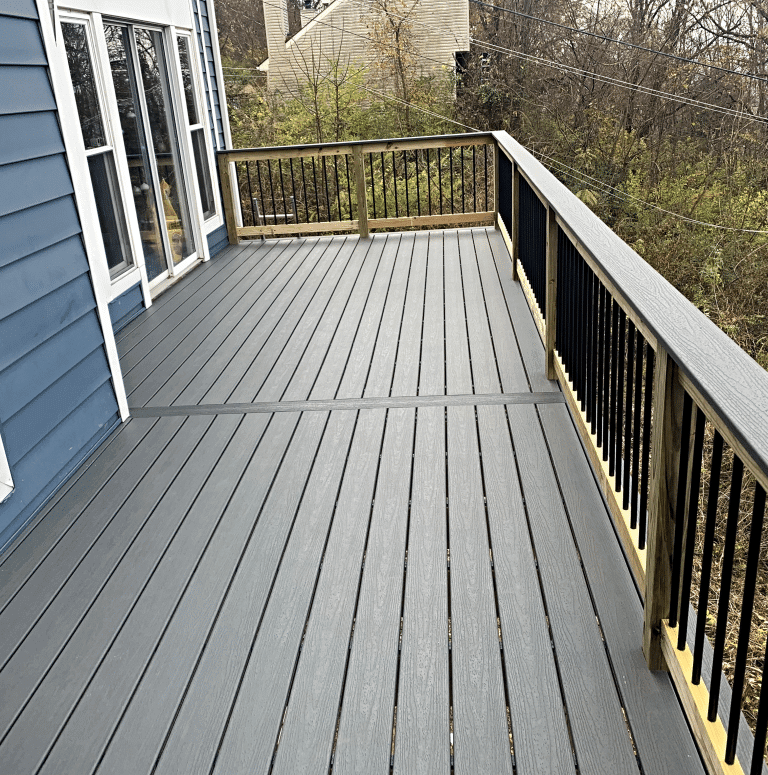
Composite boards are made from wood fibers bound with plastic — often recycled content on both sides. The result looks like wood, works like wood under a saw, and behaves nothing like wood once it's exposed to weather.
The key property is that it doesn't absorb water. Wood takes on moisture, swells, dries, and shrinks, and that cycle is what eventually causes cupping, splintering, and rot. Composite skips the cycle entirely, which is why it holds up in a humid climate where wood struggles.
The main brands you'll encounter are Trex and TimberTech. Both offer several product tiers, and the difference between the entry line and the premium line is mostly about capping, color realism, and warranty length.
⁃ Side by Side ⁃
Composite vs. Pressure-Treated Wood
The honest comparison, without the marketing on either side.
| Composite | Pressure-treated wood | |
|---|---|---|
| Up-front cost | Higher — often close to double on materials | The least expensive way to build a deck |
| Maintenance | Sweep and rinse. No staining, sealing, or sanding. | Clean, sand, and re-stain every two to three years |
| Lifespan | 25+ years, commonly with a 25–50 year warranty | 10–15 years, and only with consistent upkeep |
| In shade or humidity | Unaffected. Doesn't absorb water. | Struggles. Mildew, cupping, and rot come faster. |
| Underfoot | No splinters. Gets hot in direct sun, especially dark colors. | Splinters as it ages. Stays cooler in sun. |
| Framing | Heavier — may need tighter joist spacing | Standard framing |
| Appearance | Consistent, holds color. Grain is convincing but repeats. | Real grain and warmth. Can be refinished or restained. |
| Refinishing | Not possible. What you install is what you have. | Can be sanded and restained to a different color |
⁃ Where Composite Wins ⁃
The Case for Composite
It doesn't need you to keep up with it
This is the real argument, and it isn't about laziness. Most homeowners genuinely intend to stain their deck every couple of years. Most stop after the second or third time. A wood deck's lifespan assumes maintenance that usually doesn't happen — which is why so many Chattanooga decks look worn out by year eight.
It suits this climate
Humid summers, heavy tree cover, and slow drying are hard on wood. On shaded lots, near the water, or under mature trees, composite is the difference between a deck that ages well and one that needs attention every spring. It's the main reason we recommend it in Soddy-Daisy and on the mountain.
No splinters
Worth more than it sounds if there are kids or dogs using the deck barefoot. Wood splinters as it weathers; composite doesn't, ever. It's the single most common thing homeowners mention after switching.
The long-term math
Composite costs more to build and nothing to keep. Wood costs less to build and something every few years. Somewhere around year eight to ten the lines cross, and after that composite is ahead. If you're staying in the house, that matters.
⁃ The Part Nobody Mentions ⁃
Four Real Drawbacks of Composite
Any builder who tells you composite has no downsides is selling. These are the four that come up most.
1. It costs more to start
There's no getting around it — the material is substantially more expensive, and the gap widens as the deck gets bigger. If the budget is tight and the deck is large, wood may be the only way to get the size you actually want.
2. It gets hot
Composite absorbs and holds heat, and dark colors hold more. On a west-facing deck in July it can be genuinely uncomfortable barefoot. Two fixes: pick a lighter color, or plan for shade with a pergola or a covered structure. This is worth thinking about hard on open sunny lots like most of Ooltewah.
3. You can't change it later
A wood deck can be sanded and restained a different color. Composite is what it is for its whole life. Older boards could also fade noticeably; current products are UV-stable and hold color far better, but the color you choose is permanent.
4. It's heavier, which affects the frame
Composite weighs more than wood and is less rigid, so it often needs tighter joist spacing than a wood deck would. That's a cost in framing material and labor. It also matters on a resurface — existing framing built for wood may not be adequate, which we check before quoting.
Not sure which one is right for your deck? We bring composite samples to the estimate so you're choosing off real boards in your own light. We'll price both materials so you can see the actual difference for your project.
⁃ Making the Call ⁃
Which One Is Right for You?
It usually comes down to three questions.
How long are you staying?
Ten years or more, composite almost always wins on total cost. Selling in three, pressure-treated is the smarter spend — you won't be there for the maintenance and the buyer won't pay a premium for the material.
How much sun does the spot get?
Heavy shade or a lot near water argues strongly for composite. Wide open and full afternoon sun argues for a lighter composite color, or for wood, or for covering it.
Will you actually maintain it?
Be honest. Wood is a good material for someone who genuinely enjoys refinishing a deck every few years. For everyone else it becomes a slow decline. There's no wrong answer, but the answer should be truthful.
Choose composite if
- You're staying in the house long term
- The deck is shaded, wooded, or near water
- Kids or dogs will be on it barefoot
- You don't want another maintenance chore
- You want it to look the same in ten years
Choose wood if
- Budget is the binding constraint and you want the size
- You're selling within a few years
- You want real grain and are willing to keep it up
- The deck gets hard sun and you want a cooler surface
- You like being able to change the color later
Where We Build
Based in Chattanooga, building across Hamilton County and into North Georgia. The right material often depends on the lot as much as the homeowner.
- Signal Mountain
- Lookout Mountain
- Ooltewah
- Hixson
- Soddy-Daisy
- Red Bank
- Collegedale
- East Brainerd
- Ringgold
- East Ridge
- Harrison
- Chattanooga
See all service areas → · What does a deck cost? → · How long does a build take? →
⁃ Common Questions ⁃